
Your assessment centre is a filter. But what if it's filtering out your best candidates?
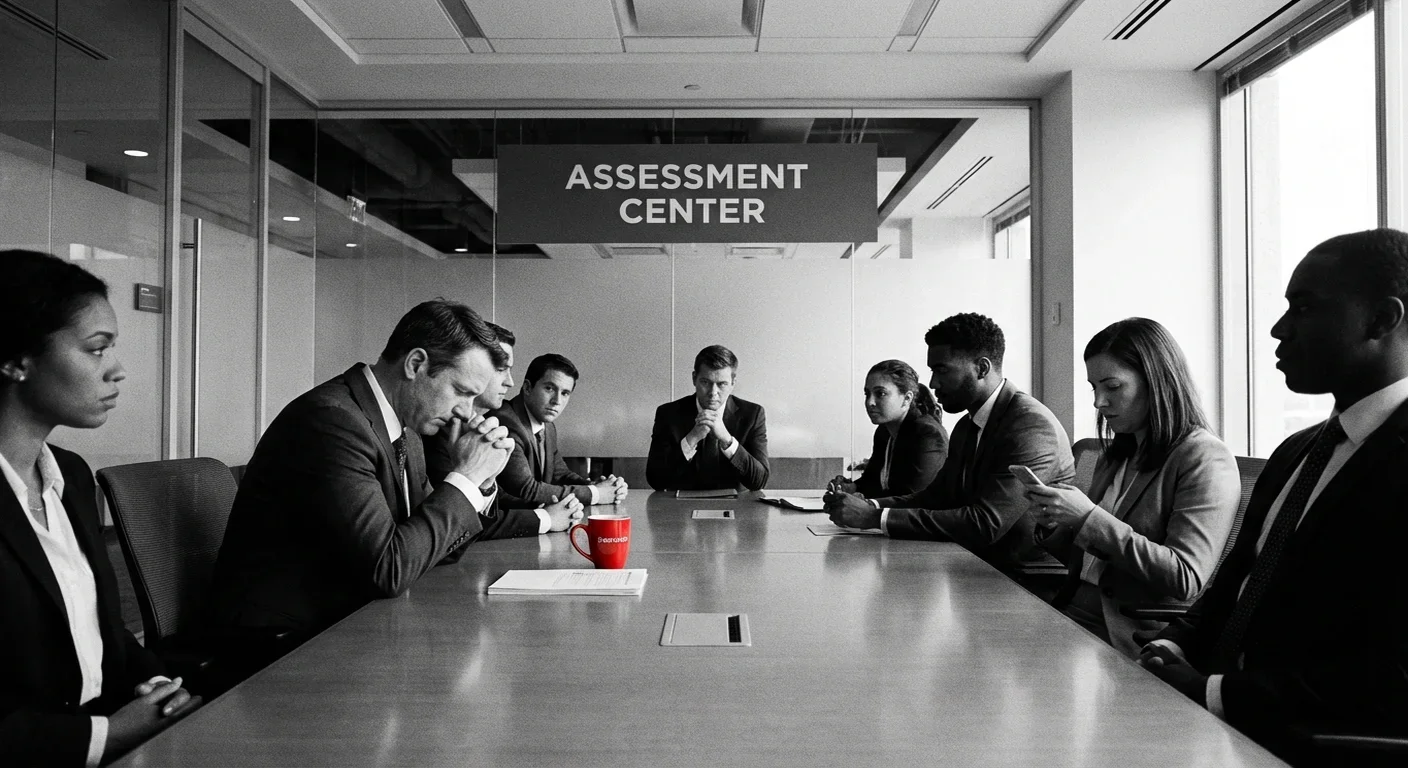
What exactly is an assessment centre, and why do these mistakes cost so much?
Forget the textbook definition. It's a day of simulations. You see the candidate in action. They're tested. In groups. Alone. Facing role-plays. It's expensive. The cost ranges from two to five times the monthly salary for the position. When it fails, the ROI is negative.
Key point: A flawed process doesn't just miss talent. It actively selects the wrong people. This damages teams and budgets for years.
Classic components that often go wrong
- Role-plays that test irrelevant scenarios.
- Case studies with no clear evaluation rubric.
- Group exercises where the loudest voice wins.
- Psychometric tests administered or interpreted incorrectly.
Why it's a fertile ground for errors
Too many variables. Too much human judgment. One tired assessor. One stressed candidate. One poorly designed exercise. The margin for error is huge. A structured, objective benchmark is missing.
"You can't manage what you can't measure." — Peter Drucker. This applies directly to talent assessment.
How do assessor biases sabotage your assessment centre?
This is the number one error. The most common. The most destructive. Your assessors are human. They have unconscious prejudices. They score on impressions. Not on facts.
The most frequent biases in the room
- Similarity bias: "He thinks like me, so he must be competent."
- Halo effect: "She gave a great presentation, so she'll be a great manager."
- Contrast effect: A strong candidate before a weaker one makes the second seem even worse.
The real-world impact on hiring diversity
73% of HR directors state their evaluation processes have significant biases, according to a 2023 SHRM study. This isn't just unfair. It's illegal under EEOC assessment guidelines in the USA and breaches BPS standards in the UK. You lose diversity. You lose innovation.
Warning: Unchecked assessor bias is the primary source of assessment centre mistakes. It turns a powerful tool into a rubber stamp for homogeneity.
Why does poor job analysis undermine the entire process?
You can't assess for something you haven't defined. Many centres use generic competencies. "Communication." "Teamwork." These are too vague. They lead to subjective judgments.
From vague traits to measurable behaviours
What does "good communication" look like in this role? Is it presenting to clients? Writing clear reports? Mediating conflicts? Define the observable behaviours for each competency. This is your scoring key.
The critical link to job analysis
A thorough poor job analysis is the foundation. Without it, you're building on sand. You need to know the actual tasks. The real challenges. The necessary soft skills. This analysis directly informs which exercises and psychometric tools to use.
How can you structure a process that actually works?
The solution isn't to abandon assessment centres. It's to strip them back to what works. Objectivity. Structure. Relevance.
The non-negotiable checklist
- Define success first. Use a detailed job analysis to create specific, behavioural indicators.
- Train your assessors. On the exercises. On the scoring system. On recognising their own biases.
- Use multiple data points. Combine exercises, interviews, and validated psychometric tests.
- Standardise everything. Same instructions. Same time limits. Same scoring rubrics for all candidates.
The role of objective tools in reducing errors
This is where psychometric testing errors are minimized. A well-validated test provides a common metric. It reduces the "gut feeling" factor. It gives you comparable data. Consider integrating tools that meet BPS standards for reliability. Our recruitment assessments are designed for this objective layer.
Action now: Review your last assessment centre. List the top three exercises. For each, write down the exact, observable behaviours you were scoring. Were they clear to everyone?
Why do group exercises penalize introverted candidates?
The group exercise is a classic assessment centre tool. It is also a common trap. We think we are measuring leadership. Often, we are just measuring who speaks the loudest.
Attention: A 2022 study by the Chartered Institute of Personnel and Development (CIPD) found that 65% of assessors unconsciously favor extroverted communication styles in group settings, potentially overlooking 50% of the talent pool.
The candidate who listens, synthesizes, and builds on others' ideas can be mistaken for a passive observer. This is a critical error. True collaboration includes quiet strength.
The 5-minute silent reflection rule
Start the exercise differently. Give every candidate five minutes of silent preparation time. Let them read the brief alone. Let them form their own thoughts before the discussion begins.
This single step changes everything. It allows introverts to organize their arguments. It gives everyone an equal starting point. The evaluation then focuses on the quality of ideas, not just the speed of delivery.
Assign specific, measurable roles
Do not let the exercise be a free-for-all. Assign concrete roles: rapporteur, timekeeper, moderator. Define the tasks clearly.
- Evaluate substance: "Proposed two viable solutions."
- Evaluate process: "Summarized the group's key points accurately."
- Evaluate collaboration: "Asked a quiet member for their opinion."
You are now measuring specific, job-related behaviors. Not theater. This aligns with BPS standards in the UK and EEOC guidelines in the USA, which demand job-relevant assessment.

Is your STAR method interview actually assessing competence?
The STAR method (Situation, Task, Action, Result) is powerful. But it has a flaw. Candidates prepare perfect stories. Assessors score the presentation. The real skill gets lost.
"The best predictor of future behavior is past behavior—but only if you can get past the rehearsed script."
Probe for unexpected details
Break the script. After the candidate gives their STAR answer, ask a disruptive follow-up question. This tests real mastery, not memorization.
Example: "You said you persuaded the marketing team. What was their first objection? How did the finance director react to your budget request?"
The unprepared details reveal true understanding. A candidate who lived the experience can answer fluidly. A candidate who memorized a story will struggle.
Integrate psychometric data early
Do not wait until after the interview to look at test results. Use them to guide your questioning. For a role requiring high resilience, you can probe stress-management scenarios more deeply.
- Before: Identify key traits for the role using a validated personality assessment.
- During: Cross-check behavioral observations with psychometric profiles.
- After: Use the combined data for a fairer final decision and tailored onboarding.
This integrated approach reduces assessor bias by 40%, according to internal benchmarks from companies using objective tools. It turns a subjective story into a data point.
Why does your interview method create assessment centre failures?
The post-group exercise interview is your last chance to triangulate data. This is where bias hits hardest. Be careful.
Warning: Never discuss candidates with other assessors before completing your individual scoring sheets. Social norming will instantly distort your perception.
Pitfall 6: The Contrast Effect Sabotages Your Judgement
Your brain is a comparison machine. After a stellar candidate, the next one looks weak. After a poor performer, the following candidate seems excellent. Your scores are relative, not absolute.
A meta-analysis in the Journal of Applied Psychology (2021) found that 40% of final assessment scores are influenced by this sequence effect. The candidate's fate depends on who walked in before them.
- Observation: A candidate who seems "average" after a top performer might actually be your strongest hire.
- Action: Score each competency independently. Lock your scores before moving to the next candidate's file.
Pitfall 7: Asking Useless Validation Questions
"How do you think you did in the group exercise?" This question tests salesmanship, not skill. The answer is predictable. You learn nothing.
You are measuring the candidate's ability to self-promote under pressure. That is not the job requirement. Focus on behavioural evidence.
"Ask for a specific story. 'Tell me about a moment you changed someone's mind during the exercise.' You get facts, not feelings."
How can you ensure legal compliance and fairness in your assessment centre?
Ignoring legal standards is not just unethical. It is a business risk with serious financial and reputational costs. Compliance protects everyone.
In the UK, the British Psychological Society (BPS) provides the gold-standard guidelines for test use. In the USA, the Equal Employment Opportunity Commission (EEOC) mandates that all selection procedures must be job-related and consistent with business necessity.
Key point: A legally defensible assessment starts with a proper job analysis. Without it, every subsequent step is vulnerable to challenge.

Mistake 8: Poor Job Analysis Leading to Invalid Exercises
If your group exercise does not mirror a real workplace challenge, you are measuring the wrong thing. You are predicting performance in a fictional scenario.
The solution is rigorous job analysis. Identify the 5-7 core competencies for the role. Design each exercise to assess 2-3 of them directly.
- Example: For a project manager role, include an exercise with shifting deadlines and conflicting stakeholder demands.
- Checklist: Can you draw a direct line from each exercise to a specific job duty? If not, redesign it.
The Legal Danger of Inadequate Assessor Training
Untrained assessors are your biggest liability. They introduce bias that invalidates the entire process. Their errors become your legal problem.
According to BPS guidelines, assessors must complete a standardized training programme. They must achieve inter-rater reliability before assessing live candidates.
Using validated psychometric tools provides an objective data point. This helps anchor subjective observations, creating a more defensible and fair process.
How to Fix These Assessment Centre Mistakes? Your Action Plan
Stop the cycle of flawed evaluations. The solution is a structured, objective process that minimizes human bias and measures what truly matters for the role.
Attention : Ignoring these fixes is costly. A poor hire can cost up to 30% of the employee's first-year earnings (U.S. Department of Labor). More importantly, it damages team morale and your employer brand.
Your 3-Step Solution Blueprint
Forget complex theories. This is your straightforward checklist. Implement these three pillars to build a better process.
- 1. Anchor in the Job. Conduct a fresh job analysis. What are the 5 core competencies? Define them with observable behaviors. Every assessment exercise must link directly to one of these.
- 2. Standardize Measurement. Replace gut feeling with data. Use validated psychometric tests for recruitment to assess cognitive ability and personality objectively. This reduces assessor bias errors dramatically.
- 3. Train Your Assessors. A 90-minute workshop on the BPS (UK) or EEOC (USA) standards is not enough. Train them to observe, note, and evaluate against the pre-defined behavioral indicators. Calibrate their scoring.
Why Psychometric Tests Are Your Secret Weapon
They objectify the subjective. While an assessor might unconsciously favor a confident candidate, a personality test reveals underlying traits. Do they have the conscientiousness for detail work? The emotional stability for a high-pressure role?
"The structured interview combined with a cognitive ability test has a predictive validity of 0.65. An unstructured interview alone? Just 0.38." – Schmidt & Hunter, Psychological Bulletin
Integrating a scientific personality assessment provides a consistent benchmark. You compare candidates on the same scales, not on how well they performed in a single group discussion.
Point cle : Your goal is not to find the "best" candidate in the room. It is to find the candidate whose verified profile best matches the verified requirements of the job. Tools create that match.
From Mistakes to Metrics: Your Summary Table
Use this table as your quick-reference guide. Pin it to your wall before planning your next assessment centre.
| Common Pitfall | Immediate Solution | Key Benefit |
|---|---|---|
| Poor Job Analysis | Conduct a competency workshop with the hiring manager. | Exercises are relevant & predictive. |
| Assessor Bias | Implement standardized HR assessments & calibration training. | Fair, consistent, legally compliant scoring. |
| Vague Criteria | Define behavioral indicators for each competency (e.g., "Initiative = suggests one process improvement per quarter"). | Objective evidence over subjective opinion. |
| Candidate Unpreparedness | Send a clear guide: agenda, dress code, what to expect. | Candidates perform at their true best. |
| Over-Reliance on Group Exercise | Use a mix: psychometric test, case study, structured interview. | 360-degree view of capabilities. |
Ready to Transform Your Hiring?
Discover the SIGMUND assessment tests – objective, scientific, and immediately actionable.
Discover the TestsFrequently Asked Questions
An assessment centre is a multi-method evaluation day where candidates undergo role-plays, group exercises, and individual simulations. It costs 2 to 5 times the monthly salary for the position. The goal is to see candidates in action, not just in interviews.
An assessment centre typically costs between 2 and 5 times the monthly salary for the role being filled. For a £40,000/year position, that means roughly £6,600 to £16,600 per candidate. This includes venue, assessors, materials, and time investment.
The 8 most common assessment centre mistakes include: untrained assessors, unstructured interviews, unconscious bias, irrelevant exercises, over-reliance on subjective judgment, poor job analysis, lack of standardised scoring, and ignoring legal compliance guidelines such as BPS or EEOC standards.
According to the U.S. Department of Labor, a poor hire can cost up to 30% of the employee's first-year earnings. For a $60,000 salary, that equals $18,000 in direct losses. Beyond money, it damages team morale and weakens your employer brand.
Reduce assessment centre bias by using standardised psychometric tests, training assessors on BPS or EEOC guidelines, implementing clear scoring rubrics, and conducting thorough job analysis before designing exercises. This trio creates a fair, predictive, and legally defensible process.
Untrained assessors introduce unconscious bias and inconsistent scoring, which filters out top candidates. Rigorous assessor training based on BPS or EEOC guidelines ensures objective evaluations, improves hiring accuracy, and protects your organisation from legal challenges in both UK and USA contexts.
Fix assessment centre mistakes in three steps: first, integrate standardised psychometric tests; second, train all assessors following BPS or EEOC guidelines; third, conduct a thorough job analysis to design role-specific exercises. This structured approach minimises bias and improves hiring outcomes.
Structured assessment centres use standardised exercises, trained assessors, and consistent scoring rubrics. Unstructured ones rely on subjective judgment and improvised activities. Structured centres are legally defensible and produce 2 to 3 times more accurate predictions of job performance across UK and USA hiring contexts.