
Luke SIGMUND Consultant
×
Discover Free Aptitude Tests Online: Enhance Your Employment Prospects
You searched for a free aptitude test online. Smart move. But before you click anything, you need to know what these tests actually measure — and what they quietly leave out.
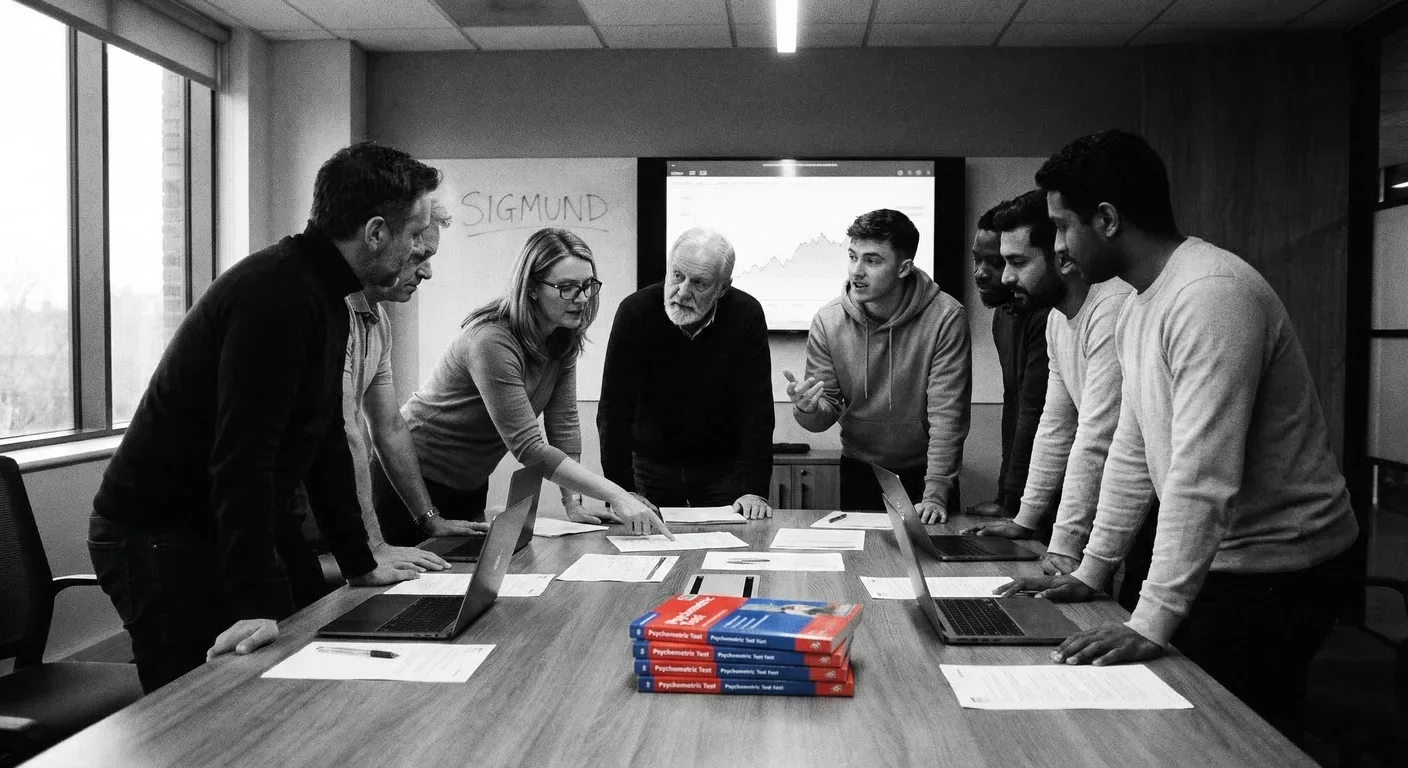
Free Aptitude Test Online: What You Will Actually Find in 2026
Every year, thousands of job seekers and HR professionals search for a free aptitude test online. The motivations differ. The frustrations are often identical.
Candidates want to prepare. Recruiters want to screen without spending budget. Both groups deserve an honest answer — not a list of links that promise science and deliver pop quizzes.
This guide cuts through that. Platform by platform. No filler.
Key point: According to the Society for Industrial and Organizational Psychology (SIOP), cognitive ability tests predict job performance with a validity coefficient of 0.51 — one of the highest of any selection method. What you choose to measure matters enormously.
Generalist Platforms: A Starting Point, Nothing More
123test.fr offers free IQ tests, personality assessments, and career questionnaires. The mini IQ test scores correct answers and shows solutions at the end of each session. For a candidate who has never seen a cognitive evaluation, this is a useful introduction.
Concours-Formation claims the largest free psychotechnical test database in France — thousands of items, with solutions, organized across three difficulty levels. Content is available directly online or as downloadable files. This format works particularly well for candidates preparing for civil service or paramedical competitive exams.
Attention: Free generalist platforms help candidates recognize question formats. They do not produce structured evaluation reports suitable for professional hiring decisions. The difference is not cosmetic — it is methodological.
Domain-Specific Resources: Built for Competitive Exams
Vocation Service Public offers 25 downloadable aptitude tests, produced in partnership with Hachette Éducation. The content covers numerical sequences, coding, matrices, logic grids, and situational exercises. Each exercise type includes a resolution method — a genuine pedagogical advantage for exam preparation.
Test-Psychotechnique-En-Ligne provides common formats including dominoes and numerical series. These formats are used by companies and public administrations in real recruitment contexts. Practicing them without cost helps candidates understand the underlying logic of HR assessments.
"The question is not whether a test is free. The question is whether it measures what you think it measures." — Frank L. Schmidt, University of Iowa, meta-analysis on personnel selection validity, 2016.
Structured Guides: Thomas.co and the Four Test Families
Thomas.co publishes a detailed aptitude test guide with free sample questions. It distinguishes four major families: numerical reasoning, verbal reasoning, logical reasoning, and situational judgment. This taxonomy is practically useful for any HR professional building an assessment framework from scratch.
Understanding which family targets which cognitive skill is not optional. A numerical reasoning test measures something fundamentally different from a verbal reasoning test — even if both appear under the label "aptitude."
- Numerical reasoning: Ability to interpret data, graphs, and calculations under time pressure
- Verbal reasoning: Capacity to draw accurate conclusions from written information
- Logical reasoning: Pattern recognition and abstract thinking independent of language
- Situational judgment: Decision quality in realistic workplace scenarios
What Free Cognitive Ability Tests Cannot Do for HR Teams
Here is the real question for a hiring manager: what happens after the test is completed?
Free platforms generate a score. Sometimes a percentile. Rarely an interpretation. Almost never a structured competency report that can be shared with a hiring panel, archived for compliance, or compared across candidates consistently.
A 2023 survey by the Chartered Institute of Personnel and Development (CIPD) found that 72% of HR professionals who use assessment tools cite reporting quality as the primary factor in their platform selection — ahead of cost.
Key point: A free psychometric test online gives you a data point. A validated professional assessment gives you a decision-support document. These are not the same thing.
The Problem With Unvalidated Free Tests
Validation is not a formality. A psychometric tool is considered valid only when it has been tested on representative populations, produces consistent results across repeated administrations, and demonstrably predicts the outcomes it claims to predict.
Most free aptitude tests available online have not undergone this process. They are built on intuition, adapted from older instruments, or simply assembled to maximize engagement rather than predictive accuracy.
The consequence for HR professionals is significant. Using an unvalidated test to screen candidates introduces legal exposure in jurisdictions where assessment fairness is regulated — including France under RGPD Article 22 and employment law provisions on non-discrimination.
What a Free Personality Test for Hiring Actually Measures
Personality questionnaires circulate freely online under names referencing the Big Five, MBTI derivatives, or proprietary frameworks. Some are genuinely useful for self-reflection. Very few are appropriate for hiring decisions.
The distinction matters for two reasons. First, personality traits must be measured through validated instruments with established normative data to be interpretable in a professional context. Second, personality assessments used in hiring carry a higher burden of fairness — they must not disadvantage candidates based on protected characteristics.
Looking for a validated alternative? Explore SIGMUND's personality assessment framework, built on scientifically verified models with normative data across professional populations.
SIGMUND: Validated Assessments With a Free Trial for HR Teams
SIGMUND is not a free aptitude test platform. It is a professional-grade assessment system designed for companies that make consequential hiring decisions.
The difference is not price. It is what you get after the test is complete.
- Structured competency reports: Each assessment produces a detailed document ready for panel review
- Scientific validation: All tests are built on established psychometric standards with documented reliability coefficients
- Candidate comparison: Normalize scores across applicants to remove subjective bias from shortlisting
- Compliance-ready documentation: Assessment data stored and processed in accordance with RGPD requirements
- Full test catalogue: Cognitive, personality, situational judgment, and skills-based assessments in one platform
Companies using structured cognitive assessments reduce mis-hire rates by up to 38% compared to unstructured interviews alone, according to meta-analytic data published by Schmidt and Hunter (1998, Psychological Bulletin). That figure has been replicated consistently across subsequent research.
Browse the full range of validated instruments in the SIGMUND HR assessment library — including numerical reasoning, verbal reasoning, and role-specific evaluations.
Not ready for a full demo? Start by understanding what professional-grade skills evaluation looks like: discover SIGMUND's skills assessment approach.
Free Aptitude Test for Employment: When Free Is Enough — and When It Is Not

The real question is not whether a test is free or paid. The real question is: what decision rests on the result?
A low-stakes decision with a reversible outcome? Free resources work. A senior hire, a team leader, a position with budget authority? The stakes change everything.
The Right Contexts for Free Cognitive Ability Tests
Free tools deliver genuine value — in the right situations. Here is exactly when they make sense.
- Candidate self-preparation. A job seeker preparing for a civil service exam or graduate recruitment process benefits directly from repetition and format familiarity.
- HR team onboarding. An HR manager new to psychometric testing can use free samples to understand structure, vocabulary, and scoring logic before committing budget.
- Internal training exercises. Free numerical reasoning tests or logical matrix puzzles are useful warm-up tools for development workshops — not for formal evaluation.
- First-pass screening in low-volume hiring. For small teams hiring junior profiles with close supervision, a free tool can help structure informal conversations.
The Contexts Where Free Psychometric Tests Become a Liability
Some situations require scientific rigor. Free tools simply cannot provide it.
Attention: Using an unvalidated free aptitude test as a hiring decision basis exposes organizations to legal risk. In France, Article L1221-6 of the Labor Code requires that any assessment method used in recruitment be directly relevant to the role and based on objective criteria. An unvalidated test does not meet that standard.
- Senior and executive recruitment. The cost of a wrong hire at this level exceeds €50,000 in most organizations, according to a 2022 SHRM estimate. A free test cannot justify that decision.
- Regulated professions. Finance, healthcare, engineering — roles where cognitive error has real consequences require validated tools with documented predictive validity.
- High-volume screening. Without standardized conditions and norm-referenced scoring, comparing 200 candidates on a free online test produces noise, not signal.
- Legal defensibility. If a rejected candidate challenges a hiring decision, you need documented methodology. A free test provides none.
What Validated Scoring Actually Means
A score of 72% on a free numerical reasoning test means nothing in isolation. Context is everything.
Professional-grade tests compare individual results against a normed population — typically hundreds or thousands of candidates in a defined reference group. A score only becomes meaningful when you know the benchmark.
"The difference between a free test and a professional tool is the difference between a bathroom scale and a medical scanner. Both give you a number. Only one allows you to make a decision."
Research published in the Journal of Applied Psychology consistently shows that cognitive ability tests with strong predictive validity correlate at 0.51 with job performance — one of the highest coefficients of any selection method. That validity does not come from the question format. It comes from the validation study behind the tool.
Free Numerical Reasoning Tests: Structure, Limits, and What HR Teams Actually Need
Numerical reasoning is the most frequently tested aptitude in corporate recruitment. And the most misunderstood.
Most free numerical reasoning tests online measure basic arithmetic speed. Professional versions measure something different: the ability to extract, interpret, and apply quantitative information under time pressure — the cognitive skill that actually predicts performance in analytical roles.
What Free Numerical Tests Typically Cover
- Number sequences. Identify the pattern, complete the series. Format familiarity matters here.
- Basic ratio and percentage problems. Useful for training. Not sufficient for role-specific screening.
- Data table reading. Some free tools include simple tables. Few include the complexity found in actual SHL or Talent Q formats.
What Professional Numerical Reasoning Tests Add
The gap is structural, not cosmetic.
- Adaptive difficulty. Items adjust in real time to the candidate's demonstrated level — producing a more precise score with fewer questions.
- Role-specific norm groups. A score is benchmarked against finance professionals, engineers, or operations managers — not a generic online population.
- Proctoring and integrity controls. Results are attributable to the actual candidate, not a helpful friend sitting beside them.
- Actionable reporting. The HR team receives a structured report, not just a percentage.
Key point: A 2023 meta-analysis by Schmidt & Hunter (updated replication) found that general cognitive ability remains the single best predictor of job performance across industries — with a validity coefficient of 0.65 when combined with a structured interview. The tool you use to measure it determines whether that predictive power transfers to your hiring process.
The Candidate Experience Problem
Free tests also create a candidate experience problem that HR teams underestimate.
When a candidate encounters a poorly designed, unbranded free test during a professional recruitment process, it signals one thing: this organization did not invest in this process. According to a 2022 Talent Board study, 58% of candidates share negative recruitment experiences publicly — on LinkedIn, Glassdoor, or directly within their professional network.
The tool you use communicates the professionalism of your organization before a single interview takes place.
Free Personality Test for Hiring: Useful Signal or Dangerous Shortcut?
Personality assessment in hiring is a separate question from cognitive testing. And a more sensitive one.
Free personality tests online — including well-known formats like the 16 Types or simplified Big Five questionnaires — have real limitations in a professional hiring context. They are not designed for employment decisions. They are designed for self-exploration.
Why Free Personality Tests Carry Specific Risks in Recruitment
- Social desirability bias. Candidates answer as the ideal candidate, not as themselves. Without forced-choice formats or validity scales, scores are easily distorted.
- No role-specific calibration. A high extraversion score is an asset for a sales role and irrelevant for a data analyst position. Generic tests cannot make that distinction.
- Legal exposure. Using personality results to exclude candidates without documented job relevance creates discrimination risk under GDPR and employment law.
- No reliability data. Test-retest reliability for most free personality tools is not published. You have no way to know if the result is stable or situational.
What a Professional Personality Assessment Provides Instead
Professional tools built on validated frameworks — including the Big Five, OPQ, or HOGAN — produce results tied to specific competency profiles. The output is not a personality label. It is a structured analysis of how a candidate is likely to behave in role-specific situations.
Explore the SIGMUND personality assessment to understand what validated personality reporting looks like in a hiring context.
The Combination That Actually Predicts Performance
The strongest hiring decisions combine cognitive ability data with personality data — interpreted against a specific role profile. Neither dimension alone is sufficient.
A candidate with high logical reasoning and low conscientiousness may underperform in execution-heavy roles. A candidate with strong interpersonal personality scores but below-benchmark numerical reasoning will struggle in a finance leadership position. Both dimensions matter. Both require validated measurement.
Free Psychometric Test Online vs. Professional Assessment: A Clear Comparison
Enough abstraction. Here is the direct comparison.
| Criterion | Free Online Test | Professional Assessment (e.g., SIGMUND) |
|---|---|---|
| Predictive validity | Not documented | Validated against job performance data |
| Norm-referenced scoring | Rarely available | Role-specific benchmark populations |
| Candidate report | Score only | Structured competency analysis |
| Legal defensibility | None | Documented methodology and criteria |
| Proctoring | Not available | Controlled or supervised conditions |
| Role customization | Generic format only | Adapted to specific role requirements |
| HR team support | None | Interpretation guidance and integration support |
| Cost | Zero | Transparent per-assessment or subscription model |
The cost column is the only one where free tools win. Every other criterion favors a validated professional tool — particularly when the hiring decision has lasting organizational consequences.
How to Move From Free Testing to a Validated Assessment Process
Most HR teams do not move from free tests to professional tools overnight. The transition is gradual — and that is entirely reasonable.
Here is a practical sequence that works.
Step 1 — Audit Your Current Practice
- List every assessment tool currently used in your recruitment process.
- For each tool: identify whether it has a published validation study.
- Identify the three roles in your organization where cognitive or personality data would most directly improve decision quality.
- Calculate the average cost of a bad hire in those roles. Include recruitment costs, onboarding time, and productivity loss. Most organizations land between €30,000 and €100,000 per failed hire.
Step 2 — Define the Decision You Are Actually Making
Not every role requires the same level of assessment rigor. Calibrate your investment to the decision weight.
- Junior, reversible roles with short probation periods: free preparation tools for candidates + structured interview for HR.
- Mid-level roles with team or budget responsibility: validated cognitive test + structured behavioral interview.
- Senior and executive roles: full assessment battery — cognitive, personality, situational judgment — with professional reporting.
Step 3 — Start With One Validated Tool on One Role Family
You do not need to overhaul your entire process. Pick one role family where hiring quality has been inconsistent. Run a validated cognitive ability test alongside your existing process for three months. Compare outcomes.
The data will make the case for broader adoption more convincingly than any internal presentation.
The SIGMUND HR assessment suite covers cognitive aptitude, personality, and professional skills — with role-specific configurations that allow exactly this kind of targeted implementation.
Key point: According to the Aberdeen Group, organizations using structured assessments in hiring report a 36% higher employee retention rate at 12 months compared to those relying on unstructured interviews alone. The ROI of validated assessment tools is measurable — and faster than most HR leaders expect.
Free Aptitude Test Online: The Honest Final Verdict
Free aptitude tests serve a real purpose. They democratize access to practice materials. They reduce test anxiety. They help candidates understand what to expect.
They are not a substitute for validated professional assessment. And they were never designed to be.
The organizations that hire best are not the ones that spend the most on assessment. They are the ones that match assessment rigor to decision weight — using free tools where preparation is the goal, and validated professional tools where the decision is consequential.
That distinction is not about budget. It is about clarity of purpose.
- Use free cognitive tests to prepare candidates and familiarize HR teams with psychometric formats.
- Use validated assessments when the hiring decision has financial, operational, or strategic consequences.
- Never use an unvalidated tool as the primary basis for rejecting a candidate from a competitive process.
- Always ask the vendor for the validation study before deploying any assessment tool in a professional context.
"Hiring is the most consequential decision most managers make. The tools you use to support that decision define the quality of your organization one hire at a time." — Adapted from Peter Cappelli, Wharton School of Business, 2019
If you want to go further than free, the SIGMUND test catalogue provides a complete view of validated assessments available for immediate deployment — cognitive aptitude, personality, professional skills, and entrepreneurial potential.
Ready to Transform Your Hiring Process?
Discover SIGMUND assessment tools — scientifically validated, objective, and immediately actionable for HR teams and hiring managers.
Explore the Assessment SuiteQuestions fréquentes
Un test d'aptitude en ligne mesure des capacités cognitives spécifiques : raisonnement verbal, numérique et logique. Il évalue la vitesse et la précision de traitement de l'information. Les tests validés psychométriquement produisent des scores normés sur des populations de référence, contrairement aux quiz génériques disponibles gratuitement.
Pour passer un test d'aptitude gratuit fiable, choisissez une plateforme qui mentionne explicitement une validation psychométrique et propose des normes de comparaison. Évitez les tests sans références méthodologiques. Des plateformes comme SIGMUND proposent un essai gratuit avec des évaluations validées, utilisées par des équipes RH professionnelles.
Un test gratuit fournit un score brut sans base de comparaison normée. Un test psychométrique payant est étalonné sur des milliers de participants, offre une fidélité mesurée (coefficient alpha supérieur à 0,80) et produit des rapports interprétables pour des décisions RH. La différence est décisive pour les recrutements à enjeux élevés.
Un test d'aptitude en ligne pour le recrutement dure généralement entre 20 et 45 minutes. Les batteries courtes (20 min) mesurent 1 à 2 dimensions cognitives. Les évaluations complètes (45 min) couvrent 4 à 6 dimensions : raisonnement verbal, numérique, spatial et logique. La durée impacte directement la fiabilité du résultat obtenu.
Les tests d'aptitude gratuits sont insuffisants pour les décisions RH critiques car ils manquent de normes de référence validées, n'indiquent pas leur marge d'erreur et ne permettent pas de comparer objectivement les candidats. Pour un poste de manager ou un recrutement senior, une erreur d'évaluation peut coûter entre 30 000 et 150 000 € à l'entreprise.
Pour interpréter un résultat de test d'aptitude cognitive, comparez le score au percentile de la population cible, pas à la moyenne générale. Un score au 70e percentile signifie que le candidat dépasse 70 % des personnes testées. Sans cette norme de référence, un score brut seul n'a aucune valeur décisionnelle concrète.
Explore the SIGMUND Test Catalog
Discover our comprehensive range of scientifically validated psychometric tests