
Luke SIGMUND Consultant
×
Cognitive Tests for Remote Work: Hiring, Memory, Attention & Flexibility
Cognitive tests remote work give you facts fast. Not noise. Not guesswork. What happens when the interview sounds good, but the day-to-day work does not?
What are cognitive tests remote work measuring?
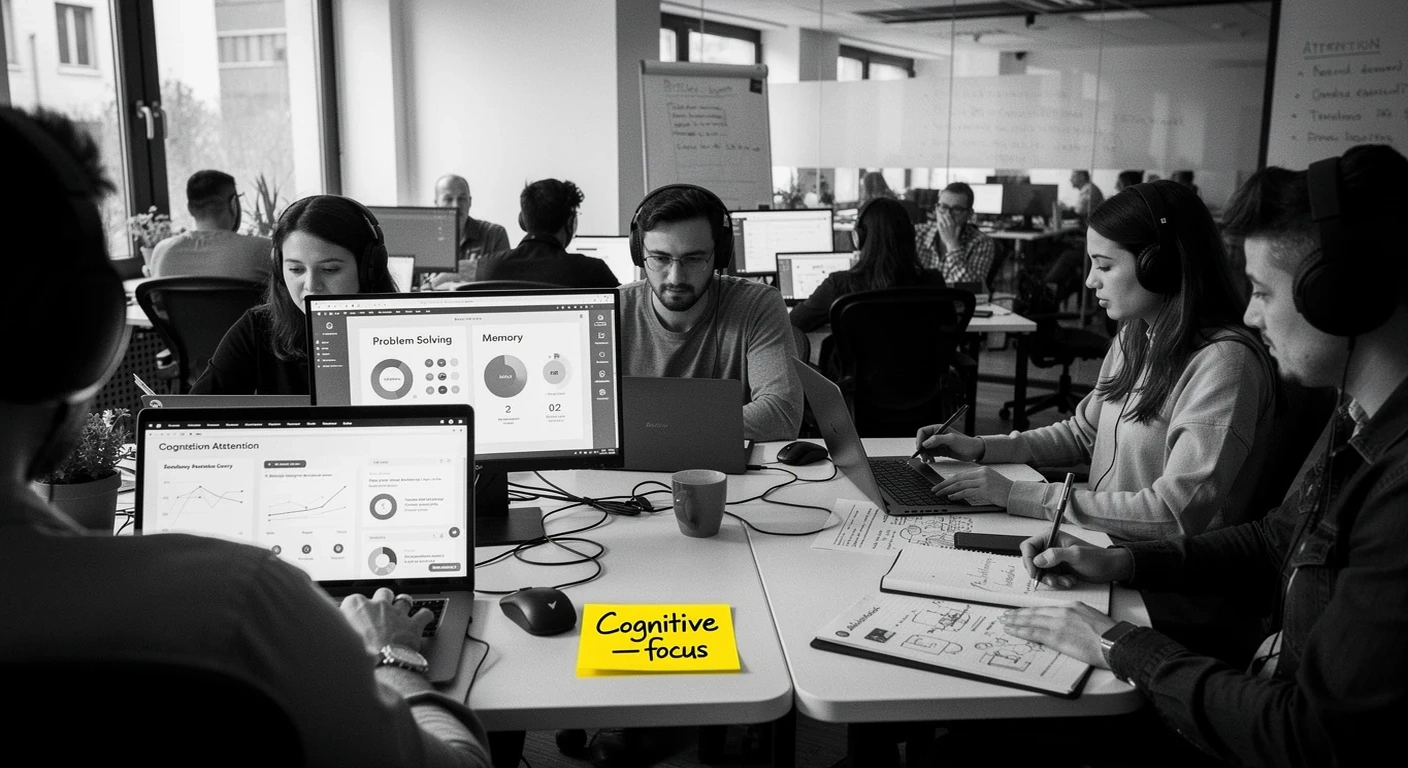
At a distance, you do not see the small things. You do not see how fast someone recovers after a message. You do not see whether focus holds when the calendar fills up. That is why cognitive tests remote work matter. They measure working memory, sustained attention, and cognitive flexibility. These are not abstract ideas. They show up in real work. A person reads a brief, answers a client, returns to a dashboard, and keeps the thread alive. That is the point. Not personality theatre. Not polished speech. Real mental performance in a remote setting.
For HR teams in the UK, this matters because remote hiring assessment needs a stable signal. The CV shows history. The interview shows confidence. The test shows performance under a clear rule. That is cleaner. It also helps when hybrid work skills matter as much as technical knowledge. A person may look strong in a meeting and still miss details after three interruptions. Another may stay calm, sort the priority, and keep accuracy high. Which one will thrive on your team?
Point cle : cognitive tests remote work help you measure abilities that interviews often leave hidden.
Why the interview alone is not enough
An interview is a moment. Remote work is a pattern. That is the problem. A candidate can sound sharp for 40 minutes and still struggle with sustained attention across a full day. Another can feel quiet in the room and still handle asynchronous communication with precision. Cognitive ability testing hiring gives you a second lens. It reduces the halo effect. It also reduces the risk of overvaluing style. The goal is not to remove human judgment. The goal is to make it fairer, calmer, and more usable.
There is also evidence behind this approach. A study in Frontiers in Psychiatry reported ICC values above 0.70 for several cognitive domains in remote administration. Another paper in Frontiers in Digital Health reported correlations from 0.62 to 0.85. Those numbers matter. They say the remote format can hold up. That is useful when the team works from home, from the office, or both.
Which abilities matter most in daily remote work?
Think about a normal Tuesday. Messages arrive. A call starts late. A document needs revision. A colleague asks for a quick answer. The people who do well are not the ones who react fastest to everything. They are the ones who keep the right information in mind, ignore distraction, and move from task to task without losing quality. That is why working memory, sustained attention, and cognitive flexibility sit at the center of remote hiring assessment. They support planning, autonomy, and decision quality. They also support feedback loops. If a person can track context, they can learn faster.
- Working memory Holds key facts while action is in progress.
- Sustained attention Keeps effort stable over time.
- Cognitive flexibility Helps a person switch task without losing the thread.
Why cognitive tests remote work matter in UK hiring
UK teams are using more remote and hybrid structures than before. That changes the signal you need. You are not only hiring for knowledge. You are hiring for how a person works when supervision is light. Cognitive tests remote work help you see that. They fit roles where planning, interruption management, and async communication are part of the day. That includes operations, support, sales support, project coordination, and many office roles with constant context switching.
There is also a compliance angle. The UK Information Commissioner’s Office is clear that data use needs purpose, minimisation, and clear retention rules. A useful benchmark is simple: keep applicant data only as long as needed. Many UK employers use a retention period around two years for CV data when a clear purpose exists. That is not a universal rule. It is a practical benchmark, not a blanket promise. If you process candidate data badly, the risk grows fast. Under UK GDPR, fines can reach 4% of global annual turnover. That is not small.
Attention : a remote test process needs clear purpose, clear communication, and tight retention. Weak process creates risk fast.
What data should you trust?
Trust the data that predicts work. Do not trust the data that only sounds polished. Predictive validity for cognitive tests often sits around 0.3 to 0.5, while interviews are often closer to 0.2. That difference is not dramatic on a slide. It is dramatic in hiring. A small gain in prediction can save time, coaching effort, and early turnover. For a team of 50 to 500 people, that compounds. One bad remote hire can slow a whole workflow. One good hire can remove friction from the first month.
“Remote work does not hide performance. It reveals it faster.”
Where SIGMUND fits
If you want a structured way to assess remote cognitive performance, start with the wider HR assessment suite or explore the full test catalogue. The point is simple. Use one clear framework. Then compare people on the same basis. That is how you get cleaner remote hiring assessment decisions. It is also how you speak with the CEO in numbers, not stories.
Cognitive tests remote work: which abilities really matter?
Point cle : cognitive tests remote work are useful when they measure what the screen reveals every day: working memory, sustained attention, and cognitive flexibility.
Remote work does not reward the loudest voice. It rewards the person who keeps a task in mind, notices what changed, and acts without drama. That is why cognitive tests remote work matter. They turn a vague feeling into a measurable signal. Does this person hold instructions under pressure? Do they stay focused when chat pings keep coming? Do they switch cleanly from one task to another?
Working memory under real pressure
Working memory is not a school word. It is the small internal space that keeps a brief in place while the day gets busy. In onboarding, this shows up fast. A new hire reads a process once. Then a manager adds a client note. Then a message arrives. Good working memory keeps the thread alive. Poor working memory creates repeats, errors, and delay. In remote hiring assessment, this is one of the clearest signals of execution quality.
Sustained attention during async work
Sustained attention is the ability to stay on the task after the first five minutes. In a home office, distraction is cheap. A doorbell. A tab. A calendar alert. A good assessment can reveal whether a person can keep focus through noise. That matters in remote teams where work is often async. No one is standing over the desk. No one rescues a missed detail. If you hire for attention, you protect quality before it breaks.
Cognitive flexibility when priorities move
Cognitive flexibility is the capacity to change course without losing control. It matters when a manager changes the order of tasks or when a client rewrites the brief at 4 p.m. In hybrid work skills, this is a daily test. A person who freezes costs time. A person who adapts keeps the team moving. Standardized digital tests can capture that response pattern in a way an interview often cannot. This is why a score can be more useful than a polished story.

Validated testing or interview: what gives the stronger signal?
Interview skill is real. So is interview noise. A candidate can sound calm, smart, and ready. Then the first week starts. The gap appears. That is the reason validated tests deserve a place in remote hiring assessment. They do not replace human judgment. They reduce guesswork. In practice, that means better screening before time is spent on long calls, panel interviews, and onboarding mistakes.
What the evidence says
Predictive validity is stronger for structured tests than for a loose conversation. A widely cited benchmark in selection research places cognitive ability testing around 0.3 to 0.5 in predictive validity, while interviews often sit closer to 0.2. That is not magic. It is method. The signal improves when the tool is standardised, scored consistently, and linked to the job. For a remote role, that link should include planning, focus, and response speed.
Why remote format changes the game
Remote assessment can be reliable when the tool is designed well. A 2025 validation study in Frontiers in Digital Health reported intraclass correlations from 0.59 to 0.83 between self-administered and clinician-administered digital cognitive tests. That is a solid range for operational use. It means the format can hold up when the process is controlled. It also means you need a clean setup, clear instructions, and the same rules for everyone.
What to compare in your process
If you want a fair benchmark, compare the same role across the same steps. Do not compare a warm interview with a vague test. Compare a structured interview with a structured test. Compare results by role family. Compare them against real performance after onboarding. That is how you learn whether the tool predicts output, not just confidence. For many SMEs, this is the point where selection gets sharper and faster.
- Use the same instructions for every applicant.
- Score against a fixed rubric.
- Link each test to one role outcome.
- Review results after onboarding, not just before offer.
How to use cognitive tests remote work without breaking compliance?
Compliance is not a side note. It is part of the design. Under UK GDPR, the ICO expects data minimisation, purpose limitation, and clear retention rules. The ICO also says personal data should not be kept longer than needed. In many UK HR processes, CV retention is often set around 2 years when there is a clear reason. That number is not a magic rule. It is a practical reference that should be documented and reviewed.
Three compliance moves that keep the process clean
First, tell applicants why the test exists. Second, keep only the data you need. Third, define who sees the score and for how long. Remote hiring assessment often creates more data than a local process. More data means more risk. A short policy beats a long apology. If a test is used for selection, say so. If it is used for development, say so. Do not blur the purpose.
What fair use looks like
A fair process does not rely on one score alone. It blends the test with work evidence, structured interview notes, and role criteria. That is especially true in remote work, where context matters. A person with high potential may still need coaching on communication rhythm. Another may excel in focus but struggle with fast escalation. The point is not to rank people by a single number. The point is to see what the number adds to the decision.
Where to anchor your toolkit
If you want a wider view of assessment options, start with the SIGMUND test catalogue and the HR assessments page. Use them as a benchmark, not a shortcut. Then decide which role needs cognitive ability testing hiring, which role needs resilience, and which role needs a different signal. That is how you build a process that is simple, defensible, and useful.
A remote hire is not proven by confidence. It is proven by repeatable performance under interruptions.
How to deploy cognitive tests remote work without chaos

Point cle : Remote assessment works when the process is simple, timed, and identical for every candidate. Not when each recruiter improvises. The goal is not more data. It is cleaner data.
Start with one role. Not ten. Pick the role where autonomy matters. Think client support lead, operations analyst, or team lead in a hybrid team. Then define the exact behaviors you need: planning, sustained attention, cognitive flexibility, and working memory. In remote work, the real question is simple. Can this person stay accurate when the day is full of interruptions?
Use the same instructions, the same timing, and the same device rules for every person. Keep the environment stable. No distractions. No last-minute exceptions. That is how you protect fairness. The HR assessments catalog helps you build a clean pathway from role needs to test choice.
Step 1: define the job reality
Write down the actual tasks. Not the ideal ones. A manager in a remote team may spend the morning in asynchronous messages, then switch to a live call, then return to a spreadsheet. That is not one skill. That is a sequence of mental shifts. Your test battery should reflect that sequence. If it does not, the data will look neat and mean very little.
- List the top 3 mental demands of the role.
- Map each demand to one test dimension.
- Decide the pass threshold before launch.
Step 2: run a small pilot
A pilot is not a luxury. It is insurance. Test 10 to 20 people who resemble your target population. Watch completion time. Watch dropout. Watch item clarity. In a 2021 Frontiers in Psychology study, remote executive testing in adolescents showed no significant group differences on most executive measures, with only a marginal effect on one 2-Back task. That is a useful signal. Remote can work when the design is disciplined.
Step 3: standardise the rollout
Make the process repeatable. Same invitation. Same reminder. Same window. Same feedback format. If one recruiter gives hints and another stays silent, your benchmark breaks. The point is not to be cold. The point is to be fair. If you need a broader structure, the test catalogue gives a faster way to compare options by role and skill.
What a good cognitive tests remote work setup looks like
A good setup reduces noise. It does not add ceremony. Use a short pre-test notice. Tell people what device to use. Tell them where to sit. Tell them that interruptions will hurt timing. That is enough. In remote work, the best assessment often looks boring. Boring is good. Boring means comparable.
Evidence supports the model. A 2022 review cited in the source material reports comparable compliance, performance, and data quality between remote and in-person collection. Another study cited there found a viable video-based MoCA administration. In the same source set, distance testing showed equivalence in 3 domains out of 4, and automated tasks achieved high completion rates. That is exactly the kind of signal HR teams need.
The setup in practice
Use a clear calendar slot. Use a short system test before the real session. Use a trained observer only when needed. Keep the candidate alone, unless the method requires supervision. If the role is customer-facing, test sustained attention. If the role is project-heavy, test working memory and cognitive flexibility. If the role changes fast, test both.
“Remote assessment is not weaker by default. Weak design is weaker.”
What to record
Record completion rate, average time, invalid sessions, and score distribution. Add one recruiter note on candidate behavior, not personality. You want facts. Did the person follow instructions? Did they recover after an error? Did they stay steady across the session? These notes give context without turning the process into opinion theater.
What to ignore
Ignore camera quality unless it blocks the method. Ignore background style. Ignore whether the office chair looks expensive. None of that predicts remote work success. A person can work from a kitchen table and still deliver strong results. The test should care about how the mind works, not how polished the room looks.
Why cognitive ability testing hiring beats interview only
Interview-only hiring feels human. It also drifts. People remember the lively answer. They forget the weak structure. They rate confidence as competence. That is a risk in remote hiring assessment, where the person who speaks well on video can look stronger than the person who thinks well under pressure. The better question is blunt. Which process predicts on-the-job performance more reliably?
Research often points to a practical answer. Cognitive tests tend to show predictive validity around 0.3 to 0.5, while interviews are often closer to 0.2. That does not make interviews useless. It makes them incomplete. Use both. Let the test measure thinking. Let the interview probe judgment, soft skills, and communication style. Do not ask one tool to do the work of three.
Where interviews still help
Interviews are useful for context. They reveal how a person explains setbacks. They show how the person handles ambiguity. They help you hear whether the person can give clear feedback or lead a team. But they should not carry the whole decision when the role depends on planning, focus, or switching tasks quickly.
Where tests add value
Tests reduce noise. They create a benchmark. They let you compare people on the same scale. That matters in UK teams where remote work mixes time zones, home interruptions, and asynchronous communication. A person who keeps accuracy high under these conditions is valuable. A person who only sounds strong in conversation may not be enough.
A simple decision rule
If the role is repetitive and structured, use a lighter battery. If the role is complex and changing, use a broader one. If the role is client-facing, add a short communication exercise. If the role is analytical, emphasize working memory and cognitive flexibility. The tool should reflect the job. That is the whole game.
How cognitive tests remote work stays compliant in the UK
Compliance is not a side note. It is part of design. Under UK GDPR, you need a lawful basis, clear purpose, data minimisation, and a retention rule. The ICO guidance is the reference point. A common retention benchmark is 2 years for CVs, unless another reason exists. That is not a slogan. It is a control.
Data breaches are costly. Under UK GDPR, fines can reach 4% of global annual turnover in serious cases. That should change behavior fast. Keep access tight. Keep storage limited. Delete what you do not need. If you use a vendor, ask where the data sits, who can see it, and how long it stays. Remote assessment does not remove risk. It changes where the risk lives.
The compliance checklist
- Explain why the test is used.
- Tell people what data you collect.
- Keep only the data you need.
- Define retention and deletion dates.
- Review vendor security before launch.
For a broader assessment framework, see the recruitment tests overview. It helps you connect method, role, and data handling without turning the process into a compliance headache.
A short note on fairness
Fairness is not only legal. It is practical. If one candidate gets extra time and another does not, the scores lose meaning. If one recruiter explains the task and another rushes it, the result is biased. Consistency is your best protection. It also improves ROI because you avoid low-quality hires that cost time, coaching, and team energy.
How to avoid the mistakes that ruin remote assessment
The biggest error is scope creep. Teams add one more test, then one more, then another. Soon the process is long, tiring, and hard to defend. The second error is using tests as a shortcut for judgment. They are not a substitute for leadership judgment. They are input. The third error is ignoring the role context. A sales role and an analyst role do not need the same battery.
Another common mistake is treating every score as final truth. A low score may mean poor sleep, tech friction, or anxiety. That is why you combine data points. You look at performance across more than one task. You look at interview evidence. You look at work sample output. Then you decide. Quietly. Clearly. Without drama.
Avoid these four traps
- Using the same test for every role.
- Skipping a pilot.
- Letting interview bias override test data.
- Keeping data too long without a retention rule.
What good looks like
Good remote assessment is short, fair, and measurable. It respects candidate time. It gives the hiring team confidence. It helps identify people who can work through interruptions, plan across the day, and stay sharp in hybrid work. That is the real aim. Not more noise. Better decisions. Better teams.
If you need a next step, start with one role, one battery, and one scorecard. Then improve. That is how mature teams build a reliable process.
Ready to transform your hiring process?
Discover SIGMUND assessment tests — objective, science-based, immediately actionable.
Discover the testsFrequently Asked Questions
Cognitive tests for remote work measure attention, memory, planning, and how quickly someone adapts to changing tasks. They help employers see whether a candidate can stay focused, manage information, and recover after interruptions. The goal is to predict real performance, not just interview confidence.
You use cognitive tests for remote work hiring because interviews often miss daily execution skills. A candidate may sound strong in conversation but struggle with focus, prioritization, or follow-through. Tests give faster, cleaner evidence and reduce guesswork when you need reliable remote performers.
Cognitive tests improve remote hiring decisions by making every candidate complete the same timed assessment. That creates comparable data on attention, memory, and problem-solving. Recruiters can spot stronger job fit earlier, lower bias, and focus interviews on the candidates most likely to succeed.
Interviews measure how well someone communicates about work. Cognitive tests measure how they process information, stay attentive, and solve tasks under pressure. The difference is simple: interviews reveal confidence, while tests reveal execution. Used together, they give a much clearer picture of remote job readiness.
Start with one critical role and test every finalist for that role. In practice, that often means 3 to 10 candidates per opening, depending on your funnel. The key is consistency: every candidate should take the same assessment, with the same timing and scoring rules.
Deploy cognitive tests without chaos by starting with one role, defining the exact skills you want, and using a simple timed process for everyone. Keep instructions identical, score with one rubric, and avoid recruiter improvisation. Clean, repeatable steps produce cleaner data and better hiring decisions.
Test Your Mastery of Remote Cognitive Assessment in Hiring
Can you separate real remote-work potential from interview polish and build a cleaner, fairer assessment process?
10 questions · ~2 minutes
📚 Related articles
Explore the SIGMUND Test Catalog
Discover our comprehensive range of scientifically validated psychometric tests