
Luke SIGMUND Consultant
×
Remote Hiring Psychometric Testing 2026: Online Recruitment Tests & Assessments
Remote hiring psychometric testing 2026 changes one thing fast. It turns a video call into a real decision.

Remote hiring psychometric testing 2026: where the real risk starts
Distance removes clues. You see less body language. You hear less context. You lose the small signals that often shape a hiring choice. That is why remote hiring psychometric testing 2026 matters. It gives the same test conditions to every applicant. It replaces guesswork with a common baseline.
Think about a recruiter on a video call. The sound stutters. The camera freezes. A strong applicant looks nervous. A quieter applicant looks flat. Which one is truly ready for the role? Online recruitment tests answer that question with more discipline. They compare remote candidate assessment results on the same scale. They also reduce the chance that presentation style gets confused with performance.
Point cle : At a distance, the interview often measures speaking style more than work behavior.
Data supports the shift. Owl Labs reported that 62% of employees worked remotely in 2026. That means the hiring process itself must adapt. The old face-to-face comfort no longer reaches every stage. If the work is distributed, the assessment needs to be distributed too. Do you want a process that rewards polish, or one that rewards real capability?
- OK Standardize every remote candidate assessment.
- OK Compare people on behavior, not on camera presence.
- OK Use online recruitment tests before the final interview.
Why video interview vs tests is not the same decision
A video interview feels fast. That is the trap. It gives a recruiter immediate comfort, not always reliable evidence. In remote hiring psychometric testing 2026, the point is not speed alone. The point is prediction. Can this person actually do the work when no one is watching all day?
Video interview vs tests is a useful comparison because each tool measures something different. A live interview captures communication style, reaction time, and surface confidence. Tests can capture logic, stability, preference patterns, and problem solving under the same rules for everyone. When both are combined, the process becomes stronger. When only the interview is used, the process often overvalues verbal ease.
Here is the daily reality. One applicant speaks with ease. Another pauses, thinks, then answers with precision. The first can look more “ready.” The second may be more effective on the job. Remote candidate assessment should expose that difference early. It should not wait until onboarding to reveal it.
The best interview is not the one that feels smooth. It is the one that predicts behavior.
In the UK and US, fairness matters too. The SIOP principles on selection methods stress validity and job relevance. That is the standard to respect. If a tool does not measure what the role requires, why keep using it?
What a video call hides
It hides fatigue. It hides hesitation. It hides the pressure of being watched. It also hides how someone handles structured tasks. A candidate may sound persuasive in five minutes and still struggle with process, priorities, or feedback. That is where virtual personality testing adds value. It gives the recruiter a wider view.
What a test reveals
It reveals consistency. It reveals response patterns. It reveals whether the person is stable under repeated prompts. It also gives a benchmark across applicants. That is hard to get from a camera alone. If the role needs accuracy, pace, and cooperation, you need evidence, not theater.
SIGMUND online tests: a cleaner way to assess remote people
SIGMUND brings remote hiring psychometric testing 2026 into one online flow. That matters because recruiters do not need another scattered process. They need a platform that supports online recruitment tests, remote candidate assessment, and personality review in one place. Less friction. More control.
The value is simple. The same person can complete validated tests from anywhere. The recruiter then sees comparable results. That helps when the shortlist is spread across states, time zones, or hybrid schedules. It also supports a more inclusive process because access is not limited to who can travel first or speak loudest on screen.
Explore SIGMUND recruitment tests and SIGMUND personality test to build a more structured remote candidate assessment. If you want the full library, visit the SIGMUND test catalogue.
Attention : A tool is only useful when the test design stays job related and consistent.
What makes the SIGMUND approach useful
It is online. It is structured. It is easy to compare. It reduces manual noise. It also fits a hybrid hiring model, where part of the process is live and part is asynchronous. That is a better use of recruiter time. It gives the CEO and the HR leader a clearer ROI on selection effort.
What to do first
- Define the role outcomes in plain language.
- Choose the test dimensions that relate to those outcomes.
- Use the same sequence for every applicant.
- Keep the interview for confirmation, not rescue.
For a broader digital setup, see the SIGMUND testing platform. It is the natural next step when a team wants more order in remote hiring psychometric testing 2026.
Remote hiring psychometric testing 2026: why video interviews are not enough
Point cle : A video interview shows presence. It does not show structure. It does not show decision quality. That is the real problem in remote hiring psychometric testing 2026.
In remote hiring, the camera flatters some people. It hides others. A confident speaker can sound ready on day one. A thoughtful person can sound slower than they really are. Which one will you trust when the role needs judgment, pace, and self-control? This is why online recruitment tests matter. They bring a second signal. They reduce the risk of hiring on polish alone. In a hybrid hiring model, that second signal is often the difference between a clean decision and a costly guess.
The data supports the shift. Owl Labs reported in 2026 that 62% of workers are remote in some form. That means more hiring decisions now happen without a full in-person read. At the same time, the SHRM has repeatedly pointed to consistency and documentation as core parts of fair selection. In practice, this means your remote candidate assessment cannot rely on charisma alone. You need evidence. You need structure. You need a process that can be explained.
What the video interview misses
A video interview captures conversation. It does not capture all work behavior. A person can answer well and still struggle with prioritization. A person can sound calm and still fold under pressure. That is why video interview vs tests is not an either-or debate. It is a sequence. The interview explores communication. The test explores traits that are harder to fake in ten minutes. Think of response speed, detail orientation, and emotional stability. Those signals help when the role depends on autonomy.
In remote settings, small signals matter more. Does the person interrupt? Do they need repeated prompts? Do they stay clear when the conversation gets more complex? These are useful notes. But they are still notes. They are not a benchmark. A validated online test gives you a standard. It lets you compare candidates against the same rule. That is what reduces noise in online recruitment tests.
- Do use the interview for motivation, clarity, and communication.
- Do use tests for traits linked to the role.
- Do not treat a smooth video call as proof of future performance.
Which roles need more proof
Some roles can survive a loose process. Many cannot. If the job requires autonomous decisions, customer judgment, or steady output without daily supervision, remote candidate assessment needs more than a conversation. A project lead. A recruiter. A sales rep. A support manager. Each one faces moments where behavior under pressure matters. The wrong hire here is not just inconvenient. It hits ROI. It creates rework. It drains the manager. It slows onboarding.
This is where virtual personality testing earns its place. Not as a shortcut. As a control. It helps spot whether the person is likely to stay organized, adapt, and work with feedback. In the UK and the US, that matters even more when teams are split across sites, time zones, and home offices. The question is simple. Are you hiring for the way someone sounds in one call, or for the way they work over months?
Attention : A test that is not linked to the role can create noise. It can also create legal risk if it looks arbitrary. Validation matters.
Online recruitment tests: what makes them valid and fair
Online recruitment tests work only when they are built on a clear logic. That logic starts with the job. What behavior predicts success? What trait matters most in month three, not just day one? Without that answer, the test becomes decoration. With that answer, it becomes a decision aid. The best remote hiring psychometric testing 2026 setups are simple to explain. They link score to role. They document limits. They avoid collecting data that does not help the decision.
The personality test and the HR assessments pages show how this logic can be used in a remote process. That matters because a test should not replace judgment. It should sharpen it. The point is not to automate trust. The point is to reduce guesswork. In remote hiring, that is a major difference.
Validation is not a nice extra
Validation tells you whether the tool measures what it claims. That is the baseline. The SIOP principles on personnel selection have long emphasized job relevance and evidence-based use. In the same spirit, an assessment should relate to the role and the decision. If it does not, why use it? Why ask a candidate to invest time in a tool that cannot support the final choice?
For remote hiring psychometric testing 2026, validation also protects the employer. It helps show that the test is part of a structured process. It helps answer the simple question: why did this person move forward? That answer matters to hiring managers. It matters to legal teams. It matters to candidates too. People accept decisions more easily when they understand the rule.
Fairness starts before the first question
Fairness is not just score review. It begins with access. Can the candidate complete the test on a standard device? Is the time window clear? Is the language simple? Does the format work on mobile? These are practical issues. They affect completion. They affect the data. They affect the candidate experience.
For a remote candidate assessment, that means the process should be consistent. Same instructions. Same timing. Same scoring rule. Same review path. The EEOC guidance on selection and disparate impact reminds employers to watch for practices that create uneven outcomes. The lesson is straightforward. If the tool changes from one candidate to the next, fairness weakens.

What SIGMUND adds in practice
SIGMUND keeps the process fully online. That sounds simple. It is. But simplicity is useful when remote work is messy. A recruiter can send the test, review results, and compare candidates in the same workflow. No paper. No extra admin. No hidden step. This supports the hybrid hiring model because it fits a distributed team without lowering the standard.
The key is not speed alone. It is control. You can benchmark responses, compare candidates on the same scale, and keep the evidence in one place. That helps when the manager asks why one profile advanced. It also helps when the CEO wants to know whether the process is improving. A good test should save time. A better test should make the reason for the decision obvious.
A remote process is not strong because it is digital. It is strong because it is consistent, explainable, and tied to the role.
- OK Define the trait before choosing the test.
- OK Use one scoring rule for every candidate.
- OK Keep the output tied to the role.
- OK Review results before the final interview.
External references matter here. The AI Act enters key application phases in 2026 for some AI-related uses, and that pushes teams to document tools and limits. Even when a psychometric test is not AI, the same discipline helps. Record what the tool measures. Record how it is used. Record why it matters. That is how remote hiring psychometric testing 2026 stays defensible. That is also how online recruitment tests move from a nice idea to a serious part of the process.
For a deeper look at the wider setup, see the test catalogue and the recruitment tests overview. If you want the platform layer itself, use the testing platform. The point is not more tools. The point is a cleaner decision path.
Remote hiring psychometric testing 2026: what to do next
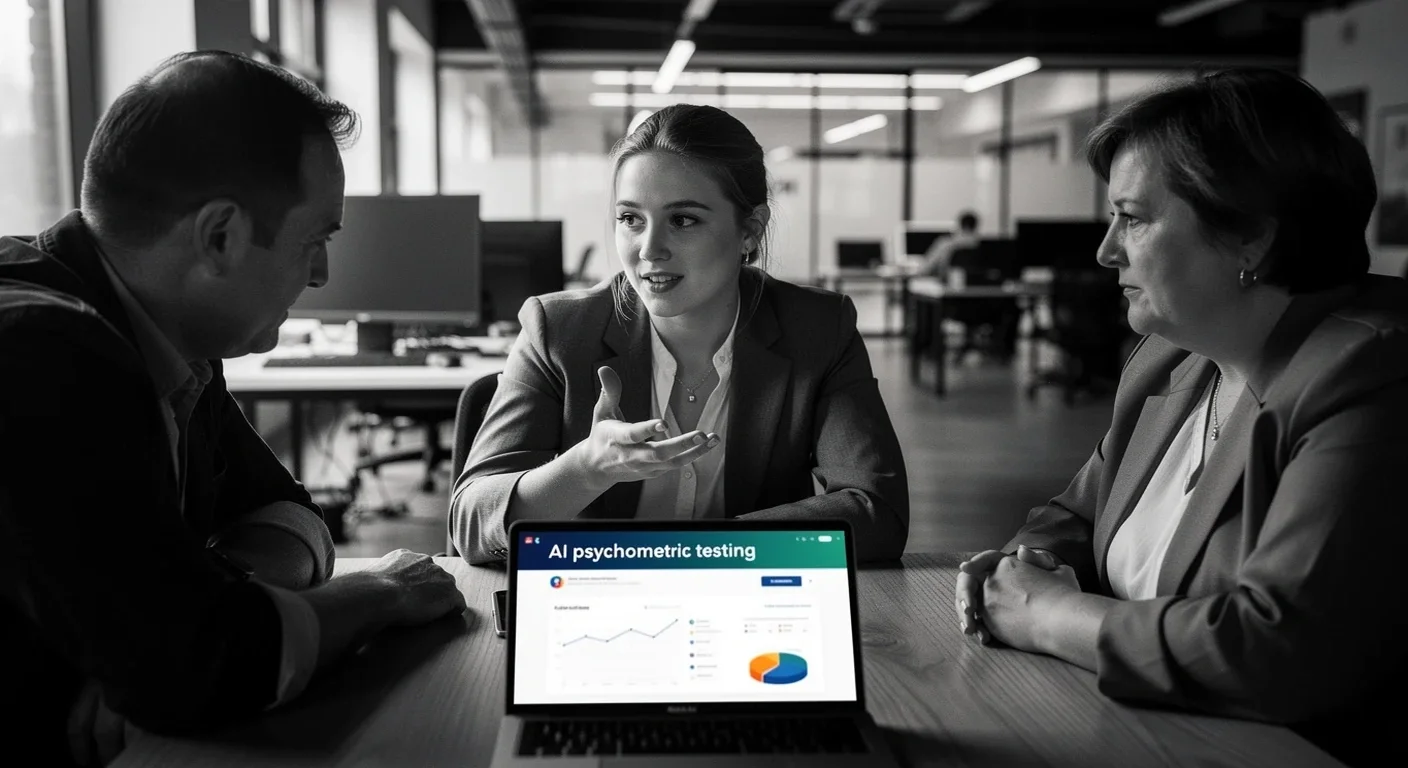
Point cle : Remote hiring fails when you trust the video call too much. A polished face is not proof of judgment, speed, or soft skills.
So what should you do now? Start by replacing guesswork with a structured online recruitment tests flow. Keep the video interview. Do not let it carry the whole decision. Use it to explore context, then use remote candidate assessment to verify behavior, logic, and personality. That is where risk drops. That is where ROI rises. The goal is not more screens. The goal is better decisions, faster.
Ask yourself a direct question. If two people sound equally strong on video, how do you know who will deliver on day one? You need evidence. You need benchmark data. You need a process that works the same way for every person. That is exactly why remote hiring psychometric testing 2026 belongs in the final stage of remote selection, not as an afterthought.
Attention : A nice interview can hide weak judgment. A structured test can reveal it in minutes.
Build a simple remote hiring flow
Use a clear sequence. First, screen the CV. Second, run a short video interview. Third, send validated online assessments. This is the hybrid hiring model that keeps speed without losing rigor. It also helps the recruiter stay fair across every person.
- Step 1 Define the role outcomes in plain language.
- Step 2 Map each outcome to one test type.
- Step 3 Compare test scores against the same benchmark.
- Step 4 Use the interview to probe evidence, not vibes.
That order matters. It stops the loudest voice from winning. It also makes the process easier to explain to the CEO and the DRH. Clear process. Clear data. Clear decision.
Video interview vs tests: why video alone is not enough
Video interview vs tests is not a debate about technology. It is a debate about signal quality. Video helps you see communication style. It does not reliably measure cognitive ability, consistency, or work style under pressure. A candidate can be calm, warm, and prepared. That still tells you little about future performance.
In remote hiring psychometric testing 2026, this matters even more. Why? Because remote teams depend on self-management. They need judgment. They need follow-through. They need coaching receptiveness. A structured test can measure those dimensions in a way a short call cannot. The personality test and HR assessments help turn opinion into evidence.
A video call tells you how someone performs on camera. A test tells you how someone may perform at work.
What video interviews miss
They miss consistency. They miss scoreable evidence. They miss the difference between confidence and competence. A person can answer well in conversation and still struggle with priority setting, learning speed, or detail control. That is why online recruitment tests should sit beside interviews, not behind them.
The SHRM has reported that structured testing can reduce time to hire by 30 percent and improve quality of hire by up to 75 percent in some contexts, while 77 percent of organizations improved hiring efficiency after adding tests. Those are not small gains. They are process gains. They are cost gains. They are hiring gains.
What tests add that interviews cannot
Tests add repeatability. They add fairness. They add a record that can be reviewed later. They also help teams reduce noise from bias and first-impression effects. If your process is remote, that matters twice as much. Distance already removes informal cues. Do not replace them with intuition alone.
- OK Use video for motivation and clarity.
- OK Use tests for evidence and comparison.
- OK Use both for a stronger final decision.
Scientific online tests: how to trust the score
Not every test deserves trust. You want validated tools. You want stable scoring. You want clear links between the score and the role. That is the heart of remote candidate assessment. It is also the reason SIGMUND stands out: it gives you 100 percent online tests that keep the same reliability you expect from in-person assessment.
According to Psico-Smart, standardized remote testing improved hiring quality for 90 percent of HR professionals in the cited ISPS 2022 report, while turnover fell by 25 to 35 percent and employee performance rose by 20 percent. Another cited SHRM-based summary says time to hire dropped by 30 percent and retention rose by 30 percent. Those numbers are not decoration. They show what happens when structure replaces guesswork.
What to verify before you deploy a test
Look for validation. Ask whether the test was built for workplace use. Ask whether it has a known scoring model. Ask whether the output is easy to explain to managers. If you cannot explain it, you cannot defend it.
- OK Confirm the construct being measured.
- OK Confirm the benchmark group.
- OK Confirm the decision rule before launch.
Which tests work well in remote hiring?
Personality tests help you spot work style and communication patterns. Cognitive tests help you estimate learning speed and problem solving. Situational judgment tests help you see how the person may react in common work moments. That mix works well in a hybrid hiring model.
Psychometric testing is not magic. It is measurement. If the role needs customer contact, ask about empathy and resilience. If the role needs analysis, ask about reasoning and precision. Use the test catalogue to build a flow that fits the role, not the other way around.
Remote supervision and fraud prevention: keep the process clean
Remote testing only works if the process stays clean. That means identity control. That means time control. That means clear instructions. It also means simple supervision rules. Do not overcomplicate it. Good design already reduces abuse.
EEOC guidance on remote testing stresses fairness and disparate impact review. SIOP standards also support structured assessment and consistent administration. Use those ideas in a practical way. Keep access equal. Keep timing clear. Keep scoring consistent. A process that is easy to follow is also easier to defend.
Point cle : The best fraud prevention is a process that leaves little room for confusion.
Simple controls that reduce risk
Use one login per person. Use time windows. Use clear browser rules. Use consistent instructions. If the role is sensitive, add a short proctored step. If the role is standard, keep the flow light. The point is control, not friction.
Owl Labs reported in 2026 that 62 percent of workers are remote, which means remote testing is now normal, not exotic. Normal processes still need guardrails. That is where the recruiter keeps credibility.
What to do when scores look suspicious
Do not panic. Review the pattern. Look at completion time. Look at score variance. Look at response consistency. Then decide whether to retest or to move the person out of process. Structured review beats instinct every time.
Need a practical setup? Start with the recruitment tests page and build the flow around the role. You will save time. You will also make your process easier to audit.
Hybrid hiring model: where video, tests, and onboarding meet
The strongest process is not video only. It is not tests only. It is a hybrid hiring model. Video gives context. Tests give evidence. Onboarding closes the loop. When these three steps connect, the candidate journey feels sharper and the hiring decision feels safer.
This is also where internal alignment matters. The recruiter, the CEO, and the DRH need the same language. Use KPI terms. Use score bands. Use role expectations. That keeps feedback useful. It also shortens the time between decision and onboarding.
A practical sequence for 2026
- Screen for minimum role criteria.
- Run a short video interview.
- Send the validated online assessment.
- Review results against the role benchmark.
- Make the decision and plan onboarding.
That sequence is simple. It is also scalable. It works for one vacancy. It works for ten. It works when the team is in London, Chicago, or fully distributed. That is the real value of remote hiring psychometric testing 2026.
Why SIGMUND fits this model
SIGMUND gives you a test catalogue that supports recruitment tests, personality test use, and broader HR assessments. It is built for online use. It is easy to deploy. It keeps the decision data in one place. That makes the recruiter faster and the process more transparent.
To see how the platform works in practice, visit the SIGMUND test platform or browse the full test catalogue. The right setup is not more work. It is better work.
Case studies and proof: what the numbers say
The evidence is strong. Psico-Smart cites a 2021 SIOP survey where 80 percent of employers improved hiring quality after adopting psychometric tests. It also cites 80 percent predictive accuracy for Pymetrics in a neuroscience-based approach, with structured tests improving hiring quality by 25 percent and reducing time to hire by 30 percent. Those figures point in the same direction. Structure works.
Another cited source says standardized tests improved candidate quality for 90 percent of HR professionals and reduced turnover by up to 35 percent. That matters after hire, not only before. A good remote candidate assessment should help the person stay, perform, and grow. If it does not, the process is incomplete.
The practical takeaway
Do not chase perfect certainty. Chase better certainty. Use structured tests to reduce error. Use interviews to explore motivation. Use onboarding to confirm the decision in real work. That is how you get a stronger ROI.
One last move. Book a review of your current process. Ask where the video interview is doing too much. Ask where evidence is missing. Then replace that weak point with validated online assessments. Start here: discover SIGMUND assessment tests.
Ready to transform your hiring process?
Discover SIGMUND assessment tests — objective, science-based, immediately actionable.
Discover the testsFrequently Asked Questions
Remote hiring psychometric testing is the use of online assessments to measure a candidate’s behavior, reasoning, personality, and job fit before hiring. It reduces guesswork, adds structure to remote recruitment, and helps employers compare candidates using consistent data instead of first impressions alone.
Psychometric tests help remote hiring because video interviews miss body language, context, and real work behavior. These tests add objective evidence on judgment, speed, and soft skills. That makes it easier to identify strong candidates and reduce costly hiring mistakes in distributed teams.
Online psychometric tests improve remote recruitment by giving hiring teams standardized results that are easy to compare across applicants. They verify logic, personality, and behavioral tendencies early in the process. This saves interview time, supports fairer decisions, and strengthens confidence in the final shortlist.
The best tests for remote candidates usually include personality, cognitive ability, and situational judgment assessments. Together, they measure how someone thinks, reacts, and works with others. For remote roles, these tests are especially useful because they reveal skills that are hard to judge in a short video call.
A remote psychometric test usually takes 15 to 45 minutes, depending on the test type and role level. Short personality assessments can take under 20 minutes, while broader test batteries may last longer. Keeping the process concise helps improve completion rates and candidate experience.
A video interview shows how a candidate communicates in one conversation, while a psychometric test measures traits and abilities in a structured way. Interviews are useful for context; tests are better for consistency and objectivity. Used together, they create a stronger remote hiring decision.
📚 Related articles
- →Explore the latest trends in assessment center psychometric testing for digital recruitment in 2026.
- →Learn how to enhance candidate experience using psychometric testing in recruitment.
- →Discover the significance of soft skills assessment through psychometric testing for recruitment success.
- →Read about the ethical considerations for AI recruitment preselection in 2026.
Explore the SIGMUND Test Catalog
Discover our comprehensive range of scientifically validated psychometric tests